
• Funding Opportunities
    • BoRSF Programs
      • BoRSF Informational Sessions
    • LA EPSCoR
    • Grant Guide at-a-Glance
  • LA EPSCoR
    • EPSCoR Programs
    • Speaking of Science (SoS)
    • Data Portal
    • Newsletters & Research Highlights
  • LOGAN
    • LOGAN Support
  • RFPs and Reports
    • RFPs & Policies
    • Consultant Reports
  • Policies & Planning
    • BoRSF Plan and Budget
    • Committees
    • State S&T Plan: FIRST Louisiana 2030
  • Unit info
    • Staff Directory
    • About
  • Announcements
  • Staff
  • Tech Transfer
Search
  • Announcements
  • Staff
  • Tech Transfer
  • Funding Opportunities
    • BoRSF Programs
      • BoRSF Informational Sessions
    • LA EPSCoR
    • Grant Guide at-a-Glance
  • LA EPSCoR
    • EPSCoR Programs
    • Speaking of Science (SoS)
    • Data Portal
    • Newsletters & Research Highlights
  • LOGAN
    • LOGAN Support
  • RFPs and Reports
    • RFPs & Policies
    • Consultant Reports
  • Policies & Planning
    • BoRSF Plan and Budget
    • Committees
    • State S&T Plan: FIRST Louisiana 2030
  • Unit info
    • Staff Directory
    • About
  • 
  • Announcements

Spotlight: December 2009

December 2, 2009 • General

Spotlight: December 2009

Black holes. You hear about them, read about them, but never see them. There is a good reason for that. While supermassive in size, with hundreds or even billion times the mass of the Sun, black holes are invisible; so compact that even the speed of light can’t escape them. They can only be found indirectly, via their effects on the matter that surrounds them.
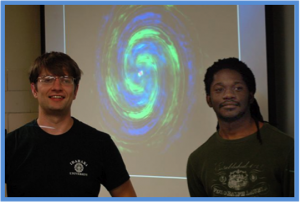
Two graduate stu- dent members of the LSU Black Hole simulation team are, left to right, Oleg Korobkin, physics, and Cornelius Toole Jr., computer science.
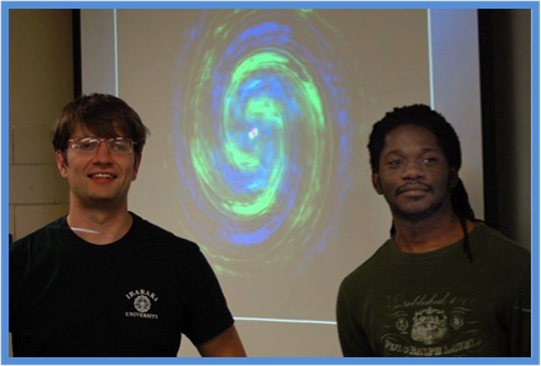
Two graduate student members of the LSU Black Hole simulation team are, left to right, Oleg Korobkin, physics, and Cornelius Toole Jr., computer science.

A team of 13 researchers and students from Louisiana State University Center for Computation & Technology (CCT), many of whom participate in Louisiana EPSCoR’s NSF-funded CyberTools project, has produced a black hole simulation project involving equations written by Albert Einstein that are so complex they can’t be written down on paper. It was the top winner in an international competition, the SCALE 2009 challenge at CCGrid09, a conference for scalable computing, in which scientists use computer systems that can easily adapt, or scale up, to provide greater performance and computing power and give them greater capability to solve complex problems.

Read more…(PDF Document)


Related Posts
BOR Funding Opportunities Webinar September 3rd

August 27, 2026

On Thursday, September 3, 10-11 a.m., the BOR Research and Sponsored Initiatives staff will host a one-hour webinar on Zoom…

Read More

FY 2026-27 BoRSF Requests for Proposals Available

July 1, 2026

Requests for proposals (RFPs) for FY 2026–27 are now available for all Board of Regents Support Fund (BoRSF) competitive programs…

Read More

  • Categories
    • BoRSF
    • EPSCoR
    • Events
    • Featured
    • front_page
    • General
    • LaSIP
    • LOGAN System Notice
    • Louisiana Board of Regents eLearning Task Force
    • Newsletter
    • Q&A
    • RFP
    • Special Programs
    • SURE
    • The Daily Feature
    • Uncategorized

    Featured Posts

    • Funding Opportunities Office Hours Available
      September 1, 2026
    • BOR Funding Opportunities Webinar September 3rd
      August 27, 2026
    • Revised Endowment Program Policies Available
      August 27, 2026
    • LOGAN Proposal Module Access Delayed
      July 20, 2026
    Return to Archive

Address
1201 N. Third St., Suite 6-200
Baton Rouge, LA 70802

Phone
(225) 342-4253

LA Office of Sponsored Programs